
Blog Article
Is Your SoC Vendor CRA-Ready? Why Security Architecture Just Became a Procurement Decision
Published on Sep 22, 2026 in Thought Leadership
Somewhere on your roadmap right now there’s a line item that says “Cyber Resilience Act (CRA) compliance” with no owner attached to it. Nobody’s sure if it’s a firmware task, a documentation task, or a procurement task — so it’s everyone’s problem and no one’s deliverable. Worse: most of what that line item requires was decided months or years ago, when someone picked the SoC.
On September 11, 2026, the CRA’s vulnerability reporting obligation went live. Manufacturers now have 24 hours to report actively exploited vulnerabilities and 72 hours for severe incidents — for products already shipping, not just new designs.
That deadline lands on the OEM. But the moment a manufacturer has to answer “what’s in this product, how fast can we patch it, and can we prove it,” the question runs to the silicon underneath. A vendor that can’t produce a clean software bill of materials (SBOM), has no public patch cadence, or can’t point to independent security certification hands you their compliance debt — on your timeline, under your company’s name on the CE mark.
This is exactly the evaluation InnoPhase IoT’s Talaria 6 Family of SoCs was built to answer well — and it’s worth walking through why, because the reasoning matters more than the name.
Three questions procurement can’t skip anymore
Software bill of materials SBOM. Can the vendor produce one, or does it require a forensic project through years of undocumented dependencies? A platform with a known, minimal component set turns SBOM generation into a starting point instead of a scramble.
Patch cadence. Is there a documented process from disclosure to patched release, with a defined support window — or does support quietly lapse once a part isn’t the flagship SKU anymore?
Independent certification. “Secure by design” is on every datasheet. The real question is whether that claim has been verified by an accredited third party, not just self-declared.
What a strong answer looks like
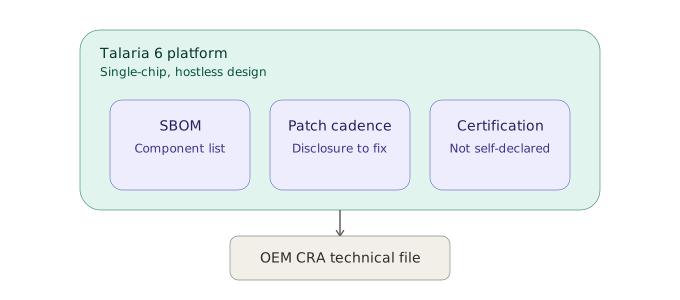
Talaria 6 is InnoPhase IoT’s family of wireless IoT SoCs, built on Wi-Fi 6 (802.11ax) with Wi-Fi 7 (802.11be)-ready features — including 802.11be extensions and multi-link operation — sold as two parts addressing different design points: the INP6120, a single-band 2.4 GHz part, and the INP6220, a dual-band 2.4/5 GHz part. Both are single-chip, hostless designs that run Wi-Fi and application processing on one die rather than pairing a radio module with a separate host MCU. That’s a smaller, more auditable component footprint from day one, which makes an SBOM shorter and a security review faster, regardless of which of the two parts a design uses.
On certification, the platform holds PSA Certified Level 2 and Matter certification, and is qualified for both AWS IoT and Azure IoT — independently verified, not self-declared. That gives an engineering team a documented answer to cite, not a promise to take on faith.
SBOM delivery and patch commitment. InnoPhase IoT makes SBOM documentation available to design partners as part of the standard technical engagement process, alongside a defined firmware support and patch process for the Talaria 6 family. Specific delivery formats and support-window details are confirmed during design-in discussions.
Where Radio Equipment Directive Delegated Act (RED DA) fits in
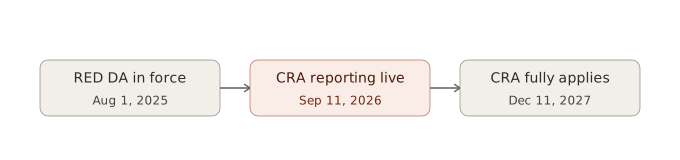
Worth a brief mention: RED DA has required internet-connected radio equipment to meet cybersecurity requirements at CE marking since August 1, 2025 — a full year ahead of CRA’s reporting obligation. A vendor whose architecture already supports RED DA conformity has a track record on the same fundamentals CRA is now expanding
Why this is an assurance decision, not just a technical one
To be precise: no SoC — from any vendor — can itself be “CRA-compliant.” CRA obligations attach to the finished product an OEM places on the market, not to a chip in isolation. Any vendor implying otherwise is oversimplifying the regulation, and a technical buyer will notice.
What a platform can do is carry the weight of that compliance work instead of adding to it. That’s the real assurance question: not “will this chip make my product compliant,” but “is the hardest part of my technical documentation already backed by verified evidence, or am I starting from a vendor’s word alone.” Talaria 6’s smaller footprint, third-party-verified certifications, and RED DA track record are exactly that kind of starting point — not a certificate to staple to a CRA file, but a stack of verified evidence to build one from.
The takeaway
CRA moved SoC selection out of the pure-engineering column and into the same category as choosing a supplier with a clean quality-management system — legal and financial consequences, not just technical ones. Vendors who answer the SBOM, patch cadence, and certification questions with independent verification make an OEM’s technical file easier to write and defend. The ones who can’t just handed their customer a harder platform to compliance-check, whatever the datasheet claims.
To learn more about the Talaria 6 Family of SoCs, request a demo, or a datasheet click here. To download the Talaria 6 product brief, click here.
FAQ
Does a chip being “secure by design” mean a product built on it is CRA-compliant?
No. CRA obligations attach to the finished product, not the component. A platform vendor’s certifications are supporting evidence for the OEM’s own technical documentation — they narrow the work, not replace it.
What is PSA Certified, and why does the level matter?
An independent security evaluation built on Arm’s Platform Security Architecture framework. Higher levels mean deeper, lab-verified assessment of secure boot, isolation, and lifecycle security — evidence an OEM can cite directly, not a vendor’s unverified claim.
Is RED DA still relevant now that CRA reporting is active?
Yes. RED DA has applied since August 1, 2025 and stays in force until CRA fully applies on December 11, 2027. A vendor’s RED DA track record is a useful, current signal of CRA readiness.
What should engineering teams ask any SoC vendor before committing?
Can they produce an SBOM for the platform, what’s their documented patch cadence and support window, and do they hold independent certification like PSA Certified rather than a self-declared claim.