
Blog Article
Built to Scale: Why We Designed the Talaria Platform from the Ground Up
Published on Jul 8, 2026 in Thought Leadership
Analog IQ radio architectures haven’t scaled with Moore’s Law for 30 years, leaving the radio as the largest power drain in battery-powered IoT designs. InnoPhase IoT’s PolaRFusion™ digital polar architecture moves RF signal processing into digital CMOS — cutting radio power consumption by up to 65% and putting wireless back on the semiconductor scaling curve.
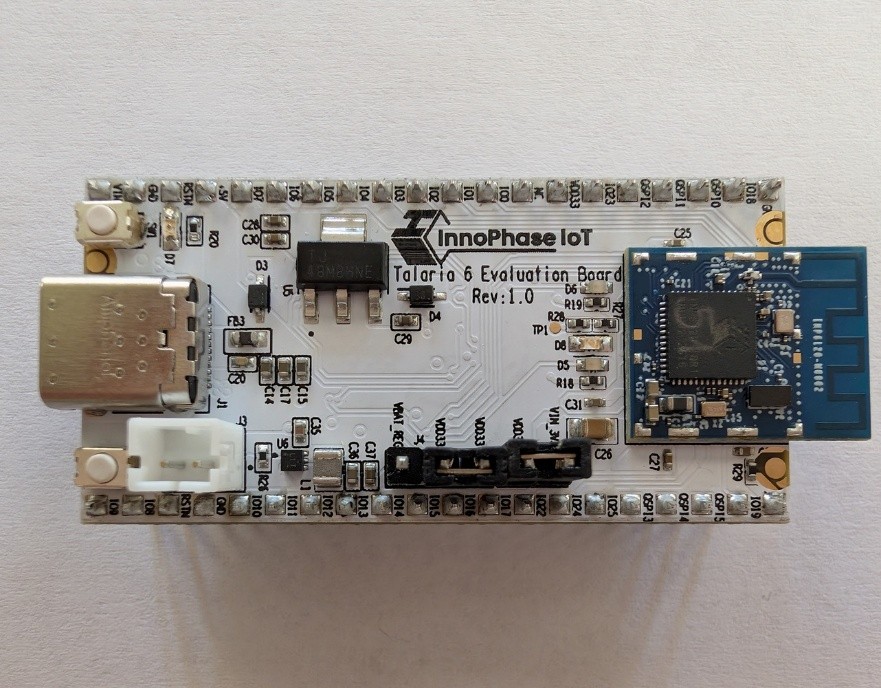
Every engineer designing a battery-powered IoT device eventually runs into the same wall: the radio. Sensors have gotten smaller, microcontrollers more efficient, and firmware smarter — but the wireless subsystem still consumes a disproportionate share of the power budget. A device that should run for years on a battery dies in months, and no amount of duty-cycle tuning fully closes the gap.
The reason isn’t a lack of engineering effort. It’s architectural. And it’s why InnoPhase IoT exists.
The Problem: Radios Fell Off Moore’s Law
For roughly 30 years, mainstream wireless chips — Wi-Fi, Bluetooth, Zigbee and beyond — have been built around IQ (in-phase and quadrature) signal representation, with the critical RF signal path implemented in analog circuits.
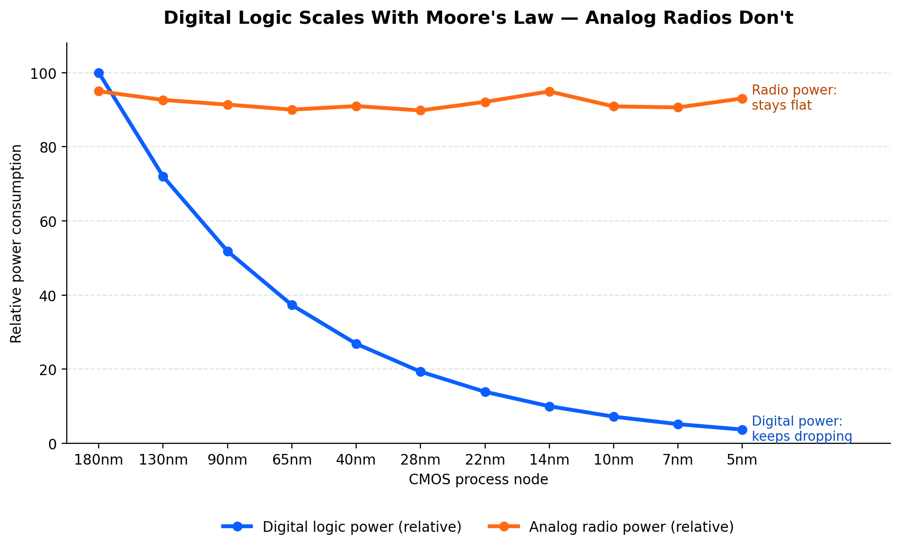
IQ radios work. But they carry a structural penalty that has become impossible to ignore: analog circuits see little benefit from semiconductor process advances. When a digital block moves to a smaller CMOS node, it gets faster, smaller, and dramatically more power-efficient. Analog blocks don’t follow. Their power consumption stays roughly flat, node after node.
The result is an industry-wide asymmetry. Processors, memory, and digital logic have ridden Moore’s Law for decades. Radios haven’t. They’ve hit a power-consumption wall — and for battery-based IoT designs, the radio is usually the single largest obstacle between a product concept and an acceptable battery life.
This wasn’t a problem IQ architectures were designed to solve. Low-power, cloud-connected, battery-operated devices weren’t on the roadmap then. Today, they are the roadmap.
The Founding Thesis: Make the Radio Digital
InnoPhase IoT was founded on a simple but demanding premise: rebuild the radio architecture itself so wireless can finally benefit from the same process-technology advances as the rest of the chip.
The outcome is the PolaRFusion™ digital radio architecture protected by a portfolio of more than 120 patents. Instead of encoding RF waveforms in Cartesian IQ coordinates processed through analog blocks, PolaRFusion encodes and decodes signals in polar coordinates — amplitude and phase — in standard digital CMOS circuits and programmable software algorithms. Even traditionally analog stages, including the low-noise amplifier (flexLNA™) and power amplifier (DPA), are implemented digitally.
Two consequences follow, and both matter to system designers:
Power. Digitizing RF signal processing cuts analog power consumption by up to 65% compared with the lowest-power IQ radios — the difference between a battery-powered product that ships and one that stalls in validation.
Scalability. Because the radio is digital-dominant, it benefits from every CMOS process advance — and because protocols run as software-programmable modules rather than fixed hardware, the same silicon can switch between Wi-Fi, BLE, and other protocols in microseconds. Protocol support becomes a software decision, not a silicon respin.
| Traditional IQ (Analog) Radio | PolaRFusion Digital Radio | |
|---|---|---|
| Signal representation | Cartesian (I/Q) | Polar (amplitude + phase) |
| Dominant circuit type | Analog | Digital CMOS |
| Benefits from process node advances | Minimal | Scales with each CMOS node |
| Protocol implementation | Fixed hardware | Software-programmable modules |
| Generational trajectory | Flat power consumption | Compounding gains per node |
The Thesis, Proven in Silicon
A radio architecture is only interesting if it holds up in production silicon — and it has, across product generations. First-generation Talaria silicon validated the digital approach in battery-powered Wi-Fi designs and earned industry recognition along the way, including a CES Innovation Award Honoree distinction, an Electronic Products Product of the Year award, a Tech Briefs Product of the Year award, and others.
The current generation is where the scaling argument pays off. The Talaria 6 family: integrates Wi-Fi 6 (Wi-Fi 7-ready), Bluetooth 6.0, Thread, and Zigbee on a single multi-protocol SoC, pairs the radio with an Arm® Cortex®-M33 running at 240 MHz for Edge AI workloads, and builds in PSA Certified Level 2 security at the silicon level — all while extending the platform’s ultra-low-power leadership with standby currents measured in tens of microamps. It’s a full IoT platform on a chip: certified connectivity stacks, Matter support, and cloud integration included, with no external MCU or radio coprocessor required.
The market has taken notice. Talaria 6 was named IoT Semiconductor Product of the Year in the 2026 IoT Breakthrough Awards and is a 2026 Best of Sensors Converge finalist for Best IoT and Connectivity Solution.
None of that is a departure from the founding thesis. It’s the thesis playing out: when the radio is digital, every generation gets meaningfully better — more throughput, more integration, more intelligence — without surrendering the power budget. And with a dual-band Wi-Fi 7 successor already in development, the trajectory continues.
We’ll go deep on the Talaria 6 numbers in an upcoming article. For now, the takeaway is simpler: the platform was designed from the ground up to scale, and it’s doing exactly that.
Key Takeaways
- Analog IQ radio architectures — the mainstream approach in wireless chips for roughly 30 years — see little benefit from CMOS process advances, leaving radios at a power-consumption wall while the rest of the chip improves.
- InnoPhase IoT’s PolaRFusion architecture moves RF signal processing into digital CMOS using polar coordinates, cutting analog power consumption by up to 65% and putting the radio back on Moore’s Law.
- Software-defined protocol processing lets one radio switch between Wi-Fi, BLE, and other protocols in microseconds — no fixed-function hardware, no respins.
- Talaria 6 delivers Wi-Fi 6, multi-protocol connectivity, Edge AI compute, and PSA Certified Level 2 security in a single SoC — and was named 2026 IoT Breakthrough Award winner for IoT Semiconductor Product of the Year.
- A digital radio isn’t just lower power today; it’s a platform whose power, integration, and intelligence improve with every process node.
Frequently Asked Questions
Why don’t analog radio circuits benefit from smaller process nodes?
Digital circuits shrink, speed up, and reduce power consumption with each CMOS process advance. Analog circuits depend on physical properties — transistor matching, linearity, noise margins — that don’t improve (and can degrade) at smaller geometries. As a result, analog-dominant radios stay roughly flat in power consumption while digital logic keeps improving.
What is a digital polar radio architecture?
Instead of representing RF waveforms as in-phase and quadrature (IQ) components processed through analog blocks, a polar architecture encodes signals as amplitude and phase, which can be processed efficiently in digital CMOS circuits and software algorithms. InnoPhase IoT’s implementation is called PolaRFusion.
What does “the radio is back on Moore’s Law” mean for my design?
It means the wireless subsystem improves generation over generation the way processors do: lower power, more integration, and more compute at each node. For designers, that translates to longer battery life, smaller bill of materials, and a platform roadmap — from Wi-Fi 6 today to Wi-Fi 7 — that doesn’t force an architecture change.
Does a software-programmable radio compromise protocol compliance?
No. The Talaria platform ships with certified Wi-Fi, Bluetooth, and Thread protocol stacks; the software-defined approach affects how signals are processed internally, not standards compliance. It adds flexibility — the same hardware can switch protocols in microseconds by loading a different radio module.
What is the Talaria 6 platform?
Talaria 6 is InnoPhase IoT’s current-generation SoC family: an IoT platform on a chip combining ultra-low-power Wi-Fi 6 (Wi-Fi 7-ready), Bluetooth 6.0, Thread, and Zigbee with PSA Certified Level 2 security, Matter support, and certified cloud connectivity — eliminating the need for external radios or coprocessors. Its dual-core MCU architecture dedicates one core to connectivity, leaving the Arm Cortex-M33 free to run application code and Edge AI at full performance.
Click here to download the Talaria 6 product brief and here to subscribe to latest Talaria platform updates.