
Blog Article
The Hardest IoT Design Challenge: Always-On Video Without a Power Cord
Published on Jul 31, 2026 in Thought Leadership
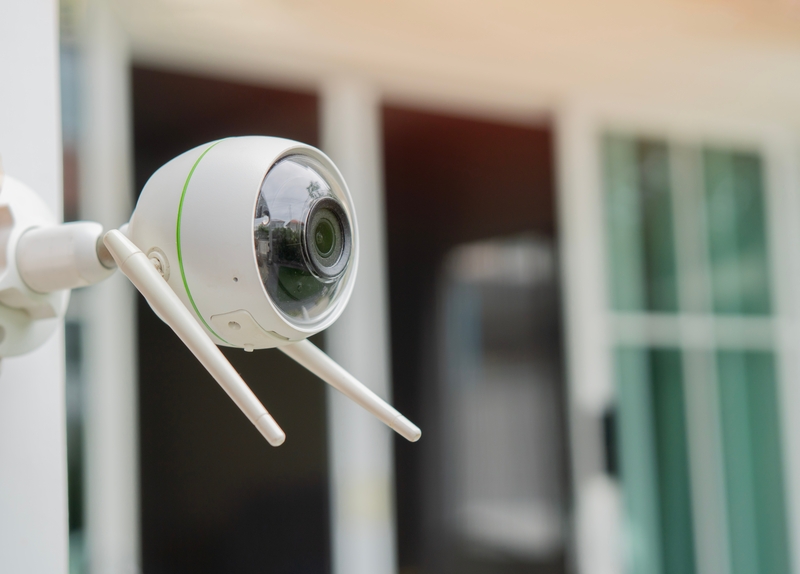
A battery-powered sensor is an easy sell: it checks in every so often, sends a tiny bit of data, and goes back to sleep. A battery-powered camera lives by a different, much less forgiving set of rules. It has to sit quietly for weeks, then the moment something actually happens — a person at the door, a car in the driveway — it needs to capture that moment and get it to a phone in a second or two. That one moment is where most of a camera’s battery life gets spent, and it’s why “always-on video” is one of the toughest problems in battery-powered product design.
Why cameras are a different kind of hard
Every battery camera on the market promises months of battery life. What that promise glosses over is what happens the instant there’s something worth recording. A door sensor reporting “open” or “closed” sends almost nothing. A camera capturing a few seconds of video sends a real file — and customers expect it to show up on their phone almost instantly, not on the camera’s own schedule.
That’s the combination that makes cameras hard: a moment you can’t predict, a real amount of data to move, and very little patience for delay — all running on a small battery, like the compact lithium batteries used in cameras and flashlights. Get this wrong, and customers see it immediately: dead batteries sooner than promised, missed doorbell moments, or a camera that lags behind what they expected to see.
How InnoPhase IoT’s Talaria 6 was built for this exact moment
Talaria 6 INP6120 was designed around that single high-stakes moment, not just the quiet hours in between. Three characteristics of the platform work together to make it possible, and preliminary chip specifications show why each one holds up in practice.
1. Negotiated wake scheduling, not fixed polling
Most low-power Wi-Fi designs wake a device on a fixed schedule — say, once every few beacons — to check whether anything is waiting, whether or not anything actually is. Every one of those check-ins costs power, even the empty ones. Target Wake Time (TWT) replaces that with a negotiated schedule: the device and the network agree on wake windows sized to what the device actually needs, so a camera can sleep far longer between routine check-ins and only spend power on a wake-up when there’s a real reason to.
This is a standard part of Wi-Fi 6 and Wi-Fi 7, so most modern Wi-Fi chips support some form of it. What matters is how efficiently a given implementation executes it. On the INP6120, preliminary characterization puts negotiated wake scheduling at roughly 103 microwatts, versus roughly 160 microwatts for a standard once-every-10-beacons check-in — cutting the power spent on idle connectivity by about half, before a single video event even happens.
2. A cleaner connection shortens the expensive part
Once a camera actually has something to send, the radio’s transmit time is where the real battery cost lives — and that cost is far more sensitive to link quality for a video clip than it ever is for a sensor reading. A stronger, cleaner signal supports faster data rates at a given range, so the same clip moves in less time and the radio gets back to sleep sooner. A weaker link that has to fall back to slower, more conservative transmission — or retry more often — ends up spending measurably more energy to move the identical file.
Talaria 6 is built around InnoPhase’s IoT’s digitally-oriented RF architecture, which is designed to sustain link quality more consistently than a conventional analog front end, particularly at the range and wall-placement realities of an actual front porch or backyard rather than bench-test distance from the router.
3. On-chip intelligence that costs almost nothing to run
A camera that has to wake a separate application processor just to decide whether a passing shadow is worth recording is paying a power tax on every false alarm. Talaria 6 integrates a high-performance Arm Cortex-M33 directly on the same chip as the wireless radio, so motion or person detection can run locally and filter out false triggers before the radio ever wakes at all.
The economics here are stark: the onboard processor draws roughly 40 milliwatts running flat-out, compared to several hundred milliwatts for an active video transmission. Filtering a false trigger locally costs a small fraction of what sending it over Wi-Fi would have cost — which is why catching it early, on-chip, is worth the design effort.
None of these three mechanisms work in isolation. Together, they mean the camera spends its battery almost entirely on moments that matter, not on overhead.
By the numbers INP6120 targeted specifications:
- Wi-Fi 6 certified and Wi-Fi 7 ready
- Negotiated wake scheduling (DTIM10): ~103 µW vs. ~160 µW for standard periodic check-ins
- Wake-to-ready time: ~550 microseconds; wake-to-transmit: ~1 millisecond
- On-chip processor: ~40 mW running at full speed — a small fraction of active radio transmission power
How this stacks up against other approaches
It’s worth being precise about what actually differentiates Talaria 6, rather than overclaiming. TWT itself is part of the Wi-Fi 6/7 standard, so most current-generation Wi-Fi chips — including competing ultra-low-power SoCs — implement some version of it. The honest differentiators are architectural and in the strength of the execution, not the existence of the feature:
- Single-chip integration. Many camera designs still pair a separate application processor with a separate radio SoC, which means two power domains and a handoff between them on every event. Talaria 6 puts wireless connectivity and application compute — including on-device motion filtering — on one chip, which removes that handoff entirely.
- A digitally-oriented RF architecture built specifically for link consistency at real-world range, rather than bench-test distance — which matters more for video’s larger payloads than it does for small sensor packets.
- Absolute efficiency numbers strong enough to stand on their own: cutting idle connectivity power roughly in half via TWT, and keeping on-chip compute at a small fraction of active radio power, are meaningful regardless of what any specific competitor’s chip does.
Why this matters for the business, not just the engineer
For a product team, this translates directly into things customers notice and reviewers write about: batteries that actually last as long as advertised, video that shows up without a noticeable delay, and fewer support calls and returns tied to “my camera died early” or “it missed the moment.” In a category where battery life and responsiveness are two of the biggest drivers of customer satisfaction — and negative reviews — getting this right is a real competitive advantage, not just an engineering detail.
The takeaway
Always-on battery video is a hard problem precisely because there’s no averaging your way around it — a single unpredictable moment carries the weight of the entire battery budget. Talaria 6 was built with that moment in mind, which is what makes it a strong fit for any product where “the camera missed it” or “the battery died early” isn’t an acceptable outcome.
FAQ
Why is a battery-powered camera harder to design than a battery-powered sensor?
A camera has to move a large, unpredictable video payload within a tight latency window, while a sensor sends a few bytes on a predictable schedule — the power cost is concentrated in the event itself, not standby time.
What is Target Wake Time (TWT) and why does it matter for cameras?
TWT lets a device negotiate a wake window with the access point sized to the data it actually needs to send, instead of checking in on a fixed schedule regardless of whether there’s anything to transmit.
Does a higher Signal to Noise Ratio (SNR) really change battery life for video devices?
Yes — a cleaner link supports higher-order modulation and fewer retransmissions, which shortens the highest-current part of the entire event: the active transmission itself.
Click here to watch the Talaria 6 video or contact sales to request a demo or receive a datasheet.